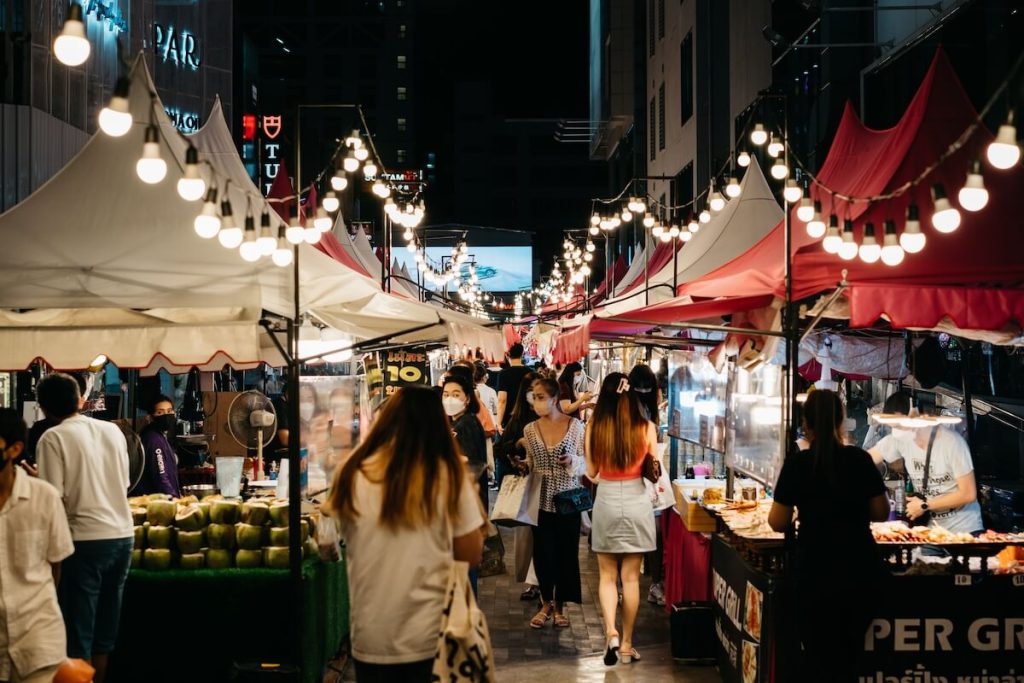
Pop-up shops, market stalls, food trucks, and seasonal spaces share one thing in common: they’re not meant to last. A pop-up might run for a weekend, a market stall for a single season, a food truck route for a summer. That impermanence leads a lot of operators to assume the usual rules around playing music for customers don’t apply to them.
That assumption is understandable, but it’s incorrect.
Temporary Doesn’t Mean Exempt
Music licensing rules are based on whether a performance is public, not on how long the venue exists or what it’s made of. If music is playing where customers can hear it, whether that’s inside a converted shipping container, from a truck window, or under a pop-up tent at a weekend market, it counts as a public performance under copyright law.
The venue’s format has no bearing on this. A tent is not exempt because it’s temporary. A food truck is not exempt because it’s mobile. A market stall is not exempt because it only operates on Saturdays. If the setup is open to the public and music is part of the customer experience, licensing obligations follow.
This catches a lot of small and seasonal operators off guard, partly because pop-up culture tends to move fast and informally. Businesses focus on permits, inventory, and setup logistics, and licensing gets overlooked simply because it doesn’t look like a fixed cost the way rent or utilities do.
The Common Scenarios Operators Ask About
A few situations come up again and again with temporary and mobile setups, and each one has a straightforward answer.
Playing from a phone or a portable speaker. This is one of the most common gray areas. Owners sometimes believe that because the setup is small, casual, or personal (a phone plugged into a Bluetooth speaker at a market table) it falls outside licensing requirements. It doesn’t. The size of the speaker and the source of the music don’t change the fact that it’s a public performance if customers can hear it.
A shared PA system at a market or fair. Larger markets and fairs sometimes run a central sound system that plays music across the entire venue rather than at individual stalls. In that case, the organizer running the PA system is generally the one responsible for the license covering that shared audio.
Short-term or single-event pop-ups. Some operators assume that because an event lasts only a day or a weekend, licensing doesn’t apply, or that it’s too much of a hassle to sort out for something so short. Duration doesn’t factor into the legal requirement, but it does affect what kind of license makes practical sense, which is where flexible, short-term options come in.
Who’s Responsible: Operator vs. Organizer
This is where a lot of the confusion sits, and it’s worth breaking down clearly.
If a market or event organizer has secured a blanket music licensing agreement, such as one covering a fairground’s shared sound system, that license typically covers music played through the organizer’s own equipment across the shared space. Individual vendors playing their own music from their own devices or speakers at their own stalls are a separate matter. Their music isn’t automatically covered just because the venue as a whole has some form of license in place.
In practice, this means:
- An organizer’s blanket license usually covers shared, centrally controlled audio (a PA system playing throughout the venue).
- Individual vendors playing their own music from their own equipment are typically responsible for their own coverage, even within a licensed venue.
- Food trucks and mobile vendors that move between locations carry their own responsibility regardless of what license, if any, a specific site or event has.
Before assuming coverage exists, it’s worth checking directly with the market or event organizer what their license actually includes. Vendors who assume they’re covered and later find out otherwise can end up facing licensing costs, or worse, an infringement claim, after the fact.
Why This Trips Up So Many Pop-Up and Market Vendors
Retail licensing rules aren’t new. Retailers already treat this as routine. Store owners researching music for retail store options, or supermarket managers looking into music for grocery store solutions, typically find licensing already bundled into whatever service they choose.
Temporary and mobile businesses don’t have that same built-in awareness because the format is newer and less standardized. A market stall doesn’t come with a lease that spells out music obligations the way a storefront rental might. A food truck’s permitting process is focused on health and safety, not copyright. So licensing tends to fall through the cracks, not out of disregard, but because nobody flagged it as something to handle.
What Makes Sense for a Temporary Setup
None of this means temporary or mobile operators need the same kind of long-term commitment a permanent retail location might take on. A seasonal market stall running for twelve weekends doesn’t need a multi-year contract, and a food truck testing out a new city for the summer shouldn’t have to commit to an arrangement built for a fixed address.
What actually fits these setups is licensing that can scale up or down with how the business operates: something that works for a single event, a short season, or an ongoing but flexible schedule, without locking the operator into terms designed for a storefront that isn’t going anywhere.
A service built around this kind of flexibility lets pop-up and market vendors get the coverage they need for exactly as long as they need it, without paying for, or committing to, more than the situation calls for. For operators who want to test this out before deciding on anything, a free trial is a low-risk way to see how a licensed music service actually works for a temporary or mobile setup, before the next market day, festival weekend, or pop-up run.