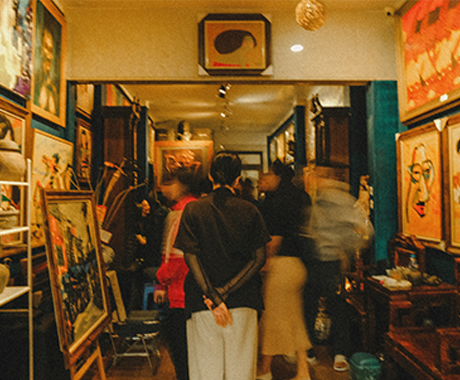
Museums and art galleries are among the few public spaces where silence is still considered a reasonable default. Many institutions keep it that way. But a growing number are rethinking that position, not to fill the quiet, but because music, when chosen carefully, can shape how visitors move through a space and how they engage with what they’re looking at.
This isn’t about adding background noise. It’s about whether sound can be part of the curatorial decision rather than an afterthought.
Why Music Decisions Are Different in Cultural Spaces
Most businesses use music to set a general mood and keep the environment from feeling flat. Museums and galleries have a more specific challenge: the work on display already carries its own meaning, and music has the potential to either support that or compete with it.
A piece of abstract expressionism sits differently in a room with drone ambient music than it does in silence, or with jazz playing softly overhead. Neither choice is automatically wrong, but each one is a choice that affects the visitor’s experience of the work.
That’s why the starting point for music in a cultural venue isn’t “what sounds good” but “what serves this exhibition.” The answer will be different for a contemporary photography show than for a collection of 18th-century portraiture, and different again for a children’s interactive gallery.
Music is one part of how an institution communicates its identity to visitors. How you connect music to your brand and environment is a question worth thinking through deliberately, especially in a setting where visitors arrive with specific expectations.
Matching Music to Exhibition Type
There’s no universal formula here, but there are useful starting points.
Contemporary and modern art exhibitions tend to give more room to experimentation with sound. Ambient, electronic, and minimalist music can work well in these spaces without pulling attention away from the work. The goal is something that creates atmosphere without asserting itself.
Historical and classical collections are often better served by restraint. Period-appropriate music can be interesting in small doses but risks feeling thematic or heavy-handed. Instrumental music with a quiet, neutral character is usually a safer choice, or silence in rooms where the work demands full attention.
Photography and documentary exhibitions sometimes benefit from music that reflects the subject matter, particularly for traveling or thematic shows. An exhibition documenting street life in 1970s New York might work well with music from that era and context. The risk is that it becomes illustrative rather than atmospheric.
Interactive and children’s galleries have different needs entirely. These are high-energy, high-noise environments where background music has to compete with activity. Upbeat, age-appropriate music that doesn’t demand attention tends to work better than anything subtle.
Permanent collections versus temporary exhibitions also call for different approaches. A rotating soundtrack for a temporary show makes sense. Running the same music through a permanent collection indefinitely will eventually become invisible to regular visitors and staff alike, which isn’t necessarily a problem, but it’s worth a periodic review.
The Visitor Flow Question
Museums and galleries often underestimate how much sound affects the pace at which people move through a space.
Slow, spacious music tends to encourage visitors to linger. Busier or more rhythmically active music subtly increases the pace of movement. Neither is inherently better, but it’s worth thinking about which you want in a given context.
A crowded temporary exhibition might benefit from music that keeps people moving steadily. A permanent gallery where you want visitors to spend time with individual works might benefit from something slower and more open.
Volume matters here too. Music that’s too quiet will be swamped by ambient noise from other visitors. Music that’s too loud becomes a distraction rather than a backdrop. The right level varies by room size and visitor density, which is a practical argument for systems that allow volume to be adjusted by zone or time of day.
Thinking carefully about how to curate music for your space is useful groundwork before committing to a specific program, particularly if you’re managing more than one gallery or exhibition space.
When Silence Is the Right Answer
It’s worth saying plainly: silence is a legitimate choice, and in some contexts it’s the right one.
Rooms with video or audio installations obviously can’t have competing music. Spaces with very intimate or emotionally demanding work, war photography, memorial exhibitions, and similar content, often feel more respectful without a soundtrack. Some collections simply don’t need music to feel complete.
The mistake is treating silence as a default that was never decided rather than as an active choice. If you’ve thought about it and concluded that music would be a distraction, that’s a decision worth standing behind.
Gallery-Specific Acoustic Considerations
Cultural spaces often present acoustic challenges that retail environments don’t. High ceilings, hard floors, stone or concrete walls, and open floor plans all create significant reverberation. Music that sounds warm and controlled in a studio can become muddy and indistinct in a large gallery space.
This affects what kind of music works well. Sparse, slower music with space between notes tends to survive reverberant environments better than dense, rhythmically complex arrangements. It also affects speaker placement: ceiling-mounted speakers pointed downward can help manage reflections better than wall-mounted speakers firing across a room.
If your building has significant acoustic challenges, it’s worth consulting with an audio professional before settling on a music program. The content decision and the hardware decision are connected, and the playback device you use affects reliability and sound quality just as much as speaker placement does.
Licensing in a Cultural Context
Museums and galleries are not exempt from music licensing requirements, a point that sometimes surprises institutions that think of themselves as non-commercial or educational.
Public performance rights apply any time music is played in a space open to the public, regardless of whether admission is charged or the institution holds charitable status. That covers background music in galleries, music used in public programming, and music played in cafes or shops within the venue.
The organizations that administer these rights in the US are primarily ASCAP, BMI, and SESAC. Understanding which performing rights organizations are relevant to your situation is a practical first step before setting up any music program.
The simplest route for most institutions is to use a licensed business music service, which handles the performing rights clearance on your behalf across its catalog. That removes the need to negotiate separately with each organization or track usage independently.
Practical Starting Points
If you’re setting up or reviewing a music program for a museum or gallery, a few things help frame the process:
Start with the exhibitions rather than the music. What is each space trying to do, and what role, if any, should sound play in that?
Think about zones. A lobby, a main gallery, a café, and a children’s area each have different needs and can reasonably run different programs. Purpose-built music for museums are designed with exactly these distinctions in mind, including licensing and content filtering that suits a public cultural setting.
Set a review schedule. Music that worked for one exhibition may not suit the next. Building in regular reassessment, particularly around exhibition changeovers, keeps the program from going stale.
Test before committing. Walk the space with the music running at different times of day and with different visitor densities. What sounds right in an empty gallery at 9am may feel different at peak capacity on a Saturday afternoon.
The goal is a sound environment that visitors don’t consciously notice but that makes the space feel considered. That’s a quieter kind of success than most, but in a museum or gallery context, it’s usually the right one.