If you play music in a business, you need to think about public performance rights. That applies to more than bars and clubs. A café, restaurant, hotel, salon, gym, or office can all run into the same issue.
Performing rights organizations, or PROs, license the public performance of songs on behalf of songwriters, composers, and publishers. They collect fees from businesses, then pay royalties to the people who own the songs. The part that trips people up is simple: one PRO license does not cover every song. Each organization controls its own catalog, so the rights you need depend on what music you play and how you use it.
It all begins with commercial music licensing that supports the atmosphere you want to create.
What Performing Rights Organizations Do
Most businesses do not license songs one by one. They use blanket licenses instead. A blanket license gives a business permission to play any song in that PRO’s catalog, as long as the use fits the license terms.
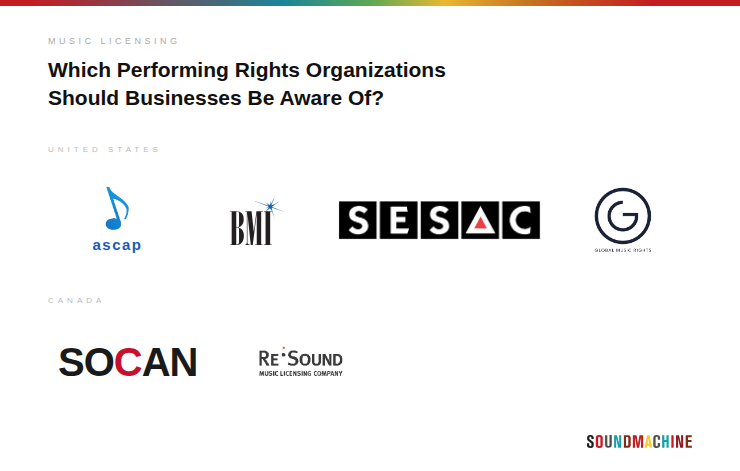
That is why PROs matter. If the music you use includes songs from more than one catalog, one license may not be enough. In the US, the main names businesses usually hear are ASCAP, BMI, SESAC, and GMR. Outside the US, the setup changes. Some countries use one main organization, while others split rights between songwriters, publishers, performers, and labels.
This is also why a personal streaming account is not the same thing as business music coverage. Paying to listen to music yourself is different from having the right to play it in a public setting. If you want a broader look at music licensing for business, we break that down in more detail there.
Which Organizations Businesses Should Know
United States
- ASCAP licenses public performances of the songs in its catalog. If your business plays ASCAP music, those rights need to be covered.
- BMI does the same job for a different catalog. A BMI license does not replace an ASCAP license because the songs represented are different.
- SESAC is another separate US PRO. Like ASCAP and BMI, it licenses the songs it represents, not the full market.
- GMR, or Global Music Rights, is also separate. It has a smaller catalog, but it can still matter depending on the music being played.
For most business owners, the difference between these groups is not the type of right they handle. The big difference is the catalog. If the songs you play are spread across multiple PROs, you may need coverage that accounts for each one.
Outside the United States
Outside the US, the names and structure change. In Canada, SOCAN covers songwriters and publishers, while Re:Sound deals with rights tied to performers and record labels. In the UK, many businesses deal with PRS for Music and PPL through TheMusicLicence. In Japan, JASRAC is the name many businesses come across first.
That matters most for businesses with more than one location or locations in more than one country. A retail store in the US and a hotel in Canada may both play background music all day, but the rights path is not exactly the same.
What Businesses Usually Need
The answer depends on both the source of the music and the way the music is used. Background music during normal business hours is one thing. A DJ set, karaoke night, live band, or cover-charge event is another.
For example, a bar might be fine using a licensed business music platform for regular daytime and evening playback, but still need separate attention for a DJ event on Friday night. A restaurant that plays background music during lunch may face different licensing questions when it starts booking live performers on weekends.
That is why it helps to think in terms of use cases. If customers or guests can hear the music in a commercial setting, rights need to be covered for that use. The more ways you use music, the more likely it is that you need more than one kind of permission.
The best thing you can do to ensure compliance is to choose a dedicated platform to handle the background music for your business.
How We Help With Background Music Licensing
We built our platform for businesses that want licensed background music without having to piece the process together on their own. When music is played through our platform, we cover public performance rights in the United States, Canada, and Japan for standard background music use.
What We Cover
- Licensed background music for commercial use through our platform
- Stations, custom stations, and mixes built for business settings
- Scheduling by time of day, day of week, or location
- Multi-user and multi-location control
- Ad-free playback, messaging, and supported integrations
That can make life much easier for businesses that just want to play background music the right way. It is especially useful for places like hotels, retail stores, salons, gyms, and offices where music is part of the customer experience every day.
When You May Need Something Else
Our licensing does not cover every possible use of music. It does not give a venue the right to hire a DJ, book a live band, run karaoke, charge a cover, or play music from outside sources like radio, TV, CDs, MP3s, or personal streaming accounts. If you want to do those things, you may need separate permissions depending on the country, venue type, and music source.
Make Music Licensing Simpler
The easiest way to avoid confusion is to match the license to the way you actually use music. If you need day-to-day background music for your business, we can help you keep that simple.
Transform your business environment with music that works as hard as you do. SoundMachine provides fully licensed, easy-to-manage background music for cafés, shops, hotels, offices, and more, helping you create the right mood without ads or interruptions. Get in touch to discover the best music solution for your business.