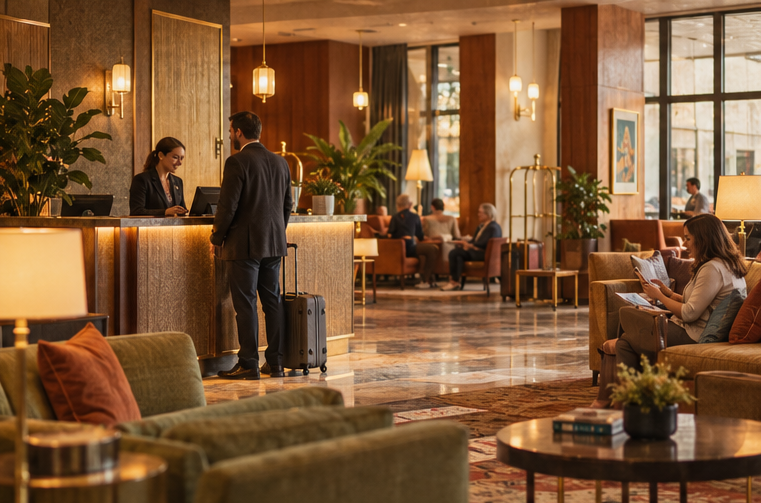
The hotel lobby is the first room guests experience and the last one they walk through on the way out. Before anyone reaches the front desk, the music has already told them what kind of stay to expect: polished, relaxed, lively or quietly luxurious.
There is no single lobby playlist that works for every property. A compact boutique lobby, a five-star resort arrival hall and a lobby café serving morning coffee are all solving different problems. The best hotel background music is chosen the same way as lighting or furniture: to fit the building, the guests and the time of day.
How to Choose a Music Playlist for Your Hotel Lobby
Before choosing a genre, work out what the lobby music needs to do. These are the factors that should shape the decision.
- Hotel type and brand identity. The soundtrack should sound like the building. A design-led boutique, a beachfront resort and a business hotel near the airport carry different expectations, and guests notice when the music does not match the décor.
- Who your guests are. Business travelers, families, couples and conference groups respond to different sounds. Properties with a mixed guest base do best with music that spans generations, such as adult contemporary, soul and vocal jazz.
- How guests use the lobby. Some lobbies are pass-through spaces where guests spend two minutes at check-in. Others hold a lounge, bar or café where guests stay for an hour. The longer people linger, the more the music matters.
- Time of day. The 7am check-out rush, the mid-afternoon arrival wave and the 10pm return from dinner are three different audiences. One all-day station has to compromise across all of them.
- Volume and acoustics. Lobbies often have stone floors, glass and high ceilings, which make music sound louder and harsher. Guests should be able to talk to the front desk without raising their voices.
- Staff who hear it all day. Guests pass through in minutes. Front desk and concierge teams hear the same playlist for a full shift, so variety matters behind the desk too.
- Consistency across properties. For groups and chains, the lobby sound is part of the brand. It should be recognizable at every location without being identical.
Hotel Lobby Music at a Glance
| Hotel Lobby Type | Atmosphere Goal | Suitable Genres | Tempo | Typical Volume | Example Tracks |
|---|---|---|---|---|---|
| Boutique hotels | Distinct, personal, welcoming | Acoustic pop, chill pop, vocal jazz, indie | Slow to mid | Low to moderate (around 55-62 dB) | “Photograph,” Ed Sheeran; “Don’t Know Why,” Norah Jones |
| Luxury and resort hotels | Calm, refined, unhurried | Classical, smooth jazz, jazz ballads, crooners | Slow | Low (roughly 50-58 dB) | “Take Five,” The Dave Brubeck Quartet; “The Way You Look Tonight,” Frank Sinatra |
| Seasonal and pop-up hotels | Bright, instantly fun | Pop dance, pool pop, 80s party | Mid to fast | Moderate (around 60-68 dB) | “Physical,” Dua Lipa; “Get Lucky,” Daft Punk ft. Pharrell Williams |
| Hotel groups and chains | Familiar, consistent, broad appeal | Pop rock, adult contemporary, acoustic rock | Mid | Moderate (around 58-65 dB) | “Yellow,” Coldplay; “She Will Be Loved,” Maroon 5 |
| Lobby cafés and coffee bars | Warm, relaxed, easy to sit with | Acoustic, bossa nova, vocal jazz, chill beats | Slow to mid | Low (around 55-60 dB) | “Desafinado,” Stan Getz and João Gilberto; “Awake,” Tycho |
Volume ranges are working guides measured at seating height, not fixed rules. Hard-surfaced lobbies may need the lower end.
Set the Right Sound From Check-In
Create a licensed lobby soundtrack that fits your property, your guests and every hour of the day.
Best Hotel Lobby Playlists by Hotel Type
Best Music Playlists for Boutique Hotel Lobbies
A boutique lobby is often the entire first impression, so the playlist needs a clear personality rather than something safe and generic. These lobbies tend to be compact, which means guests hear the soundtrack more directly than they would in a large atrium.
The common mistake is reaching for the trendiest station available. Music that is too niche ends up performing a brand rather than expressing it. Mellow acoustic sounds and understated vocal jazz age better and stay welcoming to a wider range of guests.
Keep volume low enough that a guest can hear the front desk clearly from the doorway.
Recommended Stations: Acoustic Pop, Chill Pop, Smooth Vocal Jazz, Indie Rock
Example tracks:
- “Photograph,” Ed Sheeran
- “Don’t Know Why,” Norah Jones
- “The Look of Love,” Diana Krall
- “Bubbly,” Colbie Caillat
- “Banana Pancakes,” Jack Johnson
- “Put Your Records On,” Corinne Bailey Rae
- “Young Folks,” Peter Bjorn and John
- “Lost in My Mind,” The Head and the Heart
- “I’m Yours,” Jason Mraz
- “Wake Up,” Arcade Fire
Best Music Playlists for Luxury and Resort Hotel Lobbies
Luxury and resort lobbies see the widest range of guests in a single day, from early check-outs to evening arrivals dressed for dinner. Many guests are arriving after a long journey, so the lobby should signal that they can slow down.
The right approach is a gradient through the day. As evening approaches, tempo slows, vocals give way to instrumentals, and volume drops so conversation never competes with the sound system. A five-star arrival hall usually suits classical, smooth jazz or crooner-era standards, kept low enough that guests only notice the music if it stops. A more casual, family-facing resort can sit comfortably with a fuller adult contemporary mix.
Recommended Stations: Classical, Smooth Jazz, 50s-60s Jazz Ballads, Crooners and Beyond
Example tracks:
- “Eine kleine Nachtmusik,” Wolfgang Amadeus Mozart
- “Take Five,” The Dave Brubeck Quartet
- “The Way You Look Tonight,” Frank Sinatra
- “The In Crowd,” Ramsey Lewis
- “Unforgettable,” Nat King Cole
- “Canon in D,” Johann Pachelbel
- “Volare,” Dean Martin
- “Ain’t Nobody,” Jeff Lorber
- “The Four Seasons: Spring,” Antonio Vivaldi
- “Landslide,” Fleetwood Mac
Best Music Playlists for Seasonal and Pop-Up Hotel Lobbies
Seasonal and pop-up hotels do not have time to build a brand impression slowly, since many guests stay once. The lobby music needs to set the mood within seconds of walking through the door.
The mistake most seasonal properties make is treating the lobby as a quiet transition space instead of a first taste of the stay. Upbeat, recognizable pop and dance tracks do more for a beach or festival-season property than a safer ambient choice. Keep the energy up during the day and ease off after 10pm, when guests in nearby rooms are trying to sleep.
Recommended Stations: Pop Dance, Pool Pop New, 1980s Party, Top Pop
Example tracks:
- “Physical,” Dua Lipa
- “Firestone,” Kygo ft. Conrad Sewell
- “Get Lucky,” Daft Punk ft. Pharrell Williams
- “1999,” Prince
- “Shake It Off,” Taylor Swift
- “Summer,” Calvin Harris
- “Walking on Sunshine,” Katrina and the Waves
- “Attention,” Charlie Puth
- “Billie Jean,” Michael Jackson
- “We Can’t Stop,” Miley Cyrus
Best Music Playlists for Hotel Group and Chain Lobbies
Chains and multi-property groups face a different challenge: keeping a consistent lobby sound across dozens of locations while adjusting for local guests and time zones.
The mistake many groups make is leaving music to whoever is on shift, which lets the brand sound drift property by property. Broadly appealing stations managed from one central account keep every lobby recognizable without sounding identical. Pop rock and adult contemporary are the safest base, since most guests half-know the songs and nobody finds them jarring.
Recommended Stations: Pop Rock, 00s Adult Contemporary, Adult Contemporary Mix (90s-10s), Acoustic Rock
Example tracks:
- “Yellow,” Coldplay
- “She Will Be Loved,” Maroon 5
- “Hey, Soul Sister,” Train
- “Gravity,” John Mayer
- “If I Ain’t Got You,” Alicia Keys
- “Better Together,” Jack Johnson
- “Counting Stars,” OneRepublic
- “Believer,” Imagine Dragons
- “Chandelier,” Sia
- “Pillowtalk,” ZAYN
Best Music Playlists for Hotel Lobby Cafés and Coffee Bars
More hotels are turning part of the lobby into a café or coffee bar, and the music in that corner can pay its way. A 13-month study on background music in coffee retail found that adding jazz between 2pm and 5pm raised daily beverage sales from 25.6 to 27.4 and lifted atmosphere ratings from 6.75 to 7.45 out of 10. The researchers calculated a return of more than 240% on the cost of the licensed music service.
The best playlists for cafés inside hotels work the same way as those in a standalone coffee shop. Warm acoustic tracks, bossa nova and vocal jazz suit morning coffee, while low-lyric chill beats suit the laptop crowd in the afternoon. For more ideas, see these coffee shop music playlists.
If the café sits in an open lobby, run it as its own zone at a slightly lower volume than the front desk area, so the two stations do not clash.
Recommended Stations: Acoustic Cafe, 60s Bossa Nova, Smooth Vocal Jazz, Chill Beats
Example tracks:
- “Desafinado,” Stan Getz and João Gilberto
- “Come Away With Me,” Norah Jones
- “Awake,” Tycho
- “Mas Que Nada,” Sérgio Mendes and Brasil ’66
- “Cheek to Cheek,” Ella Fitzgerald and Louis Armstrong
- “Una Mattina,” Ludovico Einaudi
- “Cry Me a River,” Julie London
- “Re: Stacks,” Bon Iver
- “Sunset Lover,” Petit Biscuit
- “Sunny,” Bobby Hebb
Hotel Lobby Stations From SoundMachine
These are SoundMachine’s 10 most-played stations at hotels and resorts, ranked by the platform’s own usage numbers. Each one is a ready-to-play station available today.
| Rank | Station | Best For | Mood | Sample Track | Best Times |
|---|---|---|---|---|---|
| 1 | Acoustic Pop | Boutique, city and family hotels | Friendly, upbeat, relaxed | “Bubbly,” Colbie Caillat | Morning, midday |
| 2 | Chill Beats | Boutique and design-led hotels, lobby cafés | Modern, mellow, low lyric | “Awake,” Tycho | Afternoon, evening |
| 3 | Smooth Jazz Instrumentals | Luxury hotels and resorts | Calm, elegant | “Ain’t Nobody,” Jeff Lorber | Evening, all day |
| 4 | Country | Mountain lodges, countryside hotels | Warm, familiar, storytelling | “5 Leaf Clover,” Luke Combs | Afternoon, evening |
| 5 | Ambient Meditation | Wellness resorts, spa hotels | Peaceful, restorative | “An Ending (Ascent),” Brian Eno | All day, late night |
| 6 | Workout | Active and adventure resorts | High energy | “Summer,” Calvin Harris | Morning, midday |
| 7 | Pop Rock | Busy city and chain hotels | Lively, steady | “Moves Like Jagger,” Maroon 5 | Afternoon check-in |
| 8 | Pool Pop New | Beach and leisure resorts | Sunny, vacation mood | “Firestone,” Kygo | Midday, afternoon |
| 9 | 80s Pop | Playful, retro-styled hotels | Nostalgic, fun | “Billie Jean,” Michael Jackson | Afternoon, evening |
| 10 | 00s Adult Contemporary | Chains and mixed-guest hotels | Familiar, polished | “Yellow,” Coldplay | All day |
1. Acoustic Pop
Upbeat and welcoming without being loud. Familiar melodies in stripped-back arrangements suit family resorts, city hotels and any lobby that wants a friendly tone at the front door.
Sample track: “Bubbly,” Colbie Caillat
2. Chill Beats
Mellow electronic rhythms in the vein of Tycho and ODESZA give boutique and design-led lobbies a modern, creative edge that appeals to younger travelers.
Sample track: “Awake,” Tycho
3. Smooth Jazz Instrumentals
Saxophone and piano instrumentals make a lobby feel calm and elegant. A natural fit for upscale resorts and luxury hotels where conversation should flow easily.
Sample track: “Ain’t Nobody,” Jeff Lorber
4. Country
Warm, familiar and full of storytelling. Helps a mountain lodge or countryside hotel feel authentic from the moment guests arrive.
Sample track: “5 Leaf Clover,” Luke Combs
5. Ambient Meditation
Airy tones and soft soundscapes instead of songs. Ideal for wellness resorts and spa hotels where the lobby should feel like the start of a retreat.
Sample track: “An Ending (Ascent),” Brian Eno
6. Workout
High-energy playlists are not the first pick for most lobbies, but in active lifestyle resorts they work well. Upbeat tracks from artists like Calvin Harris and Dua Lipa build excitement for a stay near ski slopes, beaches or hiking trails. Schedule it for mornings and midday, and switch to something calmer by evening.
Sample track: “Summer,” Calvin Harris
7. Pop Rock
Catchy hooks with a bit of rock energy. Works in busy lobbies with steady traffic, keeping the room moving without overwhelming it.
Sample track: “Moves Like Jagger,” Maroon 5
8. Pool Pop New
Sunny tropical house in the style of Kygo. Brings vacation energy indoors for beachfront hotels and leisure resorts, even at check-in.
Sample track: “Firestone,” Kygo
9. 80s Pop
Playful and nostalgic without feeling dated. Works for hotels that want a fun, stylish lobby with instant recognition.
Sample track: “Billie Jean,” Michael Jackson
10. 00s Adult Contemporary
Polished radio hits from artists like Coldplay, John Mayer and Alicia Keys. Recognizable and modern without being distracting, which makes it one of the most versatile lobby choices.
Sample track: “Yellow,” Coldplay
Try These Stations in Your Lobby
Play any of these stations, schedule them by time of day and import playlists you already use. Licensing is included.
How Music Affects the Hotel Guest Experience
Music and Guest Behavior
Lobby music is one of the few parts of a hotel that every guest experiences, and the research on its effect is consistent.
How common it is. A study of 35 Miami Beach hotels found background music playing in 68.5% of lobbies and 81.25% of food and beverage outlets. The same research linked music to higher guest enjoyment and longer, higher-spending visits in dining areas.
Satisfaction and time in the lobby. A 2024 study on hotel lobby music and customer satisfaction combined guest questionnaires and interviews and found that lobby background music had a significant impact on customer satisfaction and on how long guests were willing to spend in the lobby.
Slower music, longer stays. A classic study on music tempo and restaurant dining time found that average dinner time rose from 45 to 56 minutes under slow-tempo music, with higher bar sales as a result. The same principle applies to lobby lounges and lobby bars, where a slower soundtrack invites guests to sit down rather than head straight to their rooms.
That extra time is where lobby music pays for itself. A guest who lingers in the lobby is a guest who orders a coffee, a drink or a table for dinner.
What Guests Want to Hear
Guests have clear preferences, and those preferences change with the time of day. In a luxury hotel guest survey on music preferences, covering more than 5,000 responses across Europe and Asia, 82% wanted classical or jazz in public areas. 49% wanted classical music in the bar during the day, but only 9% wanted it there at night.
The same lesson applies to lobbies: a single all-day playlist will be wrong for part of the day. Scheduling is covered further below.
The Effect of Tempo and Volume
Loud, fast music works against most lobbies. An analysis of 2,357 online reviews of 28 hotels found that guests judged loud volume and fast tempo negatively, while music that fit the hotel’s environment was viewed positively.
As a working guide, normal conversation sits around 55 to 65 dB. A lobby is comfortable when a guest can speak to the front desk in a normal voice from a few feet away. Walk the lobby during check-in and check the seating areas, the desk and the entrance, since a level that feels right at noon can disappear at 6pm when the lobby fills.
Music, Acoustics and Lobby Layout
The same playlist sounds different in different lobbies. Marble floors, glass walls and double-height ceilings reflect sound and make music feel harsher, while rugs, upholstered seating and planting absorb it.
The fix is usually more speakers at lower volume rather than fewer turned up. Large lobbies benefit from zones, such as entrance, front desk, lounge seating and café, so each area runs at its own level and, where it makes sense, its own station.
How to Organize Lobby Music Throughout the Day
The best hotels schedule music the way they schedule service. Setting it in advance means nobody at the front desk has to remember to change it.
Early morning and check-out. Calm acoustic, light jazz or soft pop at low volume. Guests are tired, often alone and thinking about the day ahead.
Late morning and midday. Brighter and more familiar. Adult contemporary or acoustic pop keeps a quieter lobby from feeling empty.
Afternoon check-in. The busiest stretch for most lobbies. Mid-tempo pop rock or adult contemporary keeps the energy moving through queues without adding stress.
Evening. More atmospheric and brand-specific. This is where a property’s identity should come through, whether that means smooth jazz, vocal standards, chill beats or pool pop.
Late night. Quieter and slower. Guests returning from dinner want a calm walk to the elevator, and rooms near the lobby need the noise floor to drop.
A city hotel might open with Acoustic Pop for early departures, shift to Pop Rock as check-ins pick up, and close the evening with Smooth Jazz Instrumentals. A resort lobby could pair Classical with a quiet midday, then move to Pool Pop as guests head out for the evening. Keep transitions gradual, and review the schedule after a few weeks rather than setting it once.
One point that rarely gets attention: guests hear the lobby playlist for a few minutes, but front desk and concierge staff hear it for an eight-hour shift. Rotating between a few approved stations keeps that from wearing on morale.
Music Beyond the Lobby
The lobby sets the tone, but guests move on to restaurants, bars, spas, pools and event spaces, each with its own needs. These music for hotels best practices cover how playlists can be tailored to different areas, and this guide to hotel music beyond the lobby looks at how the sound should shift zone by zone. For the full guest journey, see how music shapes guest perception from check-in to check-out.
Managing Lobby Music Across Multiple Hotels
For a hotel group or chain, lobby music is part of brand consistency in the same way as signage, uniforms and service standards. It is also the element most likely to drift, because it is the easiest for someone on shift to change.
Centralized management solves most of this:
- Brand consistency. Every property should sound like the same brand, even when the lobbies differ.
- Local flexibility. A downtown property and an airport hotel may need different energy, so allow controlled variation rather than identical playlists.
- Central control. Approved stations set at head office, with clear limits on what each property can change.
- Scheduling across time zones. Day-part schedules pushed out centrally and adjusted for local time.
- Playlists you already have. Properties that built playlists on a personal Spotify or Apple Music account can import them into a licensed account rather than starting over.
- Listening data. Reports on what is actually playing, and which stations work, beat sticking with whatever was chosen on opening day.
The practical detail is covered in this guide to managing music across multiple business locations, and the licensing side in franchise and multi-location music licensing.
Do Hotels Need Licensed Music?
Yes. Playing music in a hotel lobby is a public performance, which is a different legal category from listening at home. Personal subscriptions to Spotify, Apple Music and YouTube are licensed for private, non-commercial use only, so a personal account playing in a lobby will not cover the business.
Covering a hotel usually means licensing through performance rights organizations such as ASCAP, BMI, SESAC and GMR in the US, or SOCAN and Re:Sound in Canada, or using a commercial music service that already holds those agreements. Requirements vary by property and territory, so confirm what applies locally rather than assuming coverage.
A commercial service like SoundMachine bundles those agreements into one subscription, so there is no need to manage separate PRO relationships for each property.
Licensed Lobby Music, Ready in Minutes
Choose your stations, schedule them by time of day and manage every property from one account.
FAQ About Hotel Lobby Playlists
Do Hotels Need a License to Play Music in Their Lobby?
Yes. Playing commercial music in public areas like lobbies requires a public performance license. Hotels can license directly through performance rights organizations or use a commercial music service that includes licensing in the subscription.
Can Hotels Use Spotify or Apple Music for Lobby Playlists?
No. Consumer platforms are licensed for personal listening only. Using them in a lobby is not compliant and can lead to fines. Playlists built on those apps can often be imported into a licensed commercial account instead.
What Type of Music Works Best in Hotel Lobbies?
It depends on the property. Luxury hotels lean toward smooth jazz, classical or crooners, boutique hotels toward acoustic pop and vocal jazz, chains toward pop rock and adult contemporary, and beach resorts toward pool pop. Music that fits the brand works better than music that is simply popular.
Should Lobby Playlists Change Throughout the Day?
Yes. Calm acoustic or jazz suits early check-outs, mid-tempo pop rock suits busy afternoon check-ins, and slower jazz or ambient tracks suit late evenings. Scheduling the changes in advance keeps the soundtrack natural all day.
Is It Important to Have Different Playlists for Different Areas of the Hotel?
Yes. The lobby might call for polished, mid-tempo music, while the spa needs calm ambient tracks and the pool can handle upbeat pop. Multi-zone controls set the right station for each space from one system.
Can Background Music Help With Noise Issues in Hotels?
Yes. A well-chosen playlist can mask unwanted sounds from elevators, ice machines and busy hallways, keeping common areas calm during high-traffic hours.
How Loud Should Music Be in a Hotel Lobby?
Loud enough to be present, quiet enough that guests can talk to the front desk without raising their voices. Most lobbies are comfortable in the mid-50s to low 60s dB, luxury lobbies lower, seasonal and pool-facing lobbies slightly higher.
What Music Should a Hotel Avoid in the Lobby?
Avoid explicit lyrics, sudden jumps in volume or tempo, and very niche genres that only part of your guests will enjoy. Fast, loud tracks are the most common complaint, especially late at night when rooms are nearby.
What Are the Best Playlists for a Hotel Lobby Café?
The same playlists that work in cafés and coffee shops: acoustic, bossa nova, vocal jazz and low-lyric chill beats. Run the café as its own zone so it does not clash with the main lobby station.
How Often Should Hotel Lobby Playlists Be Changed?
Review them quarterly, with seasonal updates in between. Rotating fresh tracks around a familiar core keeps the lobby from sounding stale to returning guests and to staff.
Can a Hotel Group Use the Same Playlist at Every Property?
It can, but most groups do better with a shared core and some local flexibility. Central management keeps every lobby on-brand while allowing for different guest profiles and time zones.
Final Thoughts
No single playlist suits every hotel lobby. The right soundtrack depends on the type of property, the guests, the time of day and how people use the space, and the hotels that get the most from music treat it as something to manage rather than something to set once.
Genre is the starting point. Volume, scheduling, acoustics and licensing are what make it work in practice.
Make Your Hotel Lobby Sound On-Brand. Try It Free.
Build a lobby soundtrack that fits your property and moves naturally from morning check-out to late-night arrivals.
References
Hertan, R. R. An Analysis of the Placement of Music in Miami Beach Hotels. UNLV Theses, Dissertations, Professional Papers, and Capstones, University of Nevada, Las Vegas. Digital Scholarship @ UNLV.
Wu, Y., & Tabari, S. (2024). “Intangible, but Effective: The Role of Hotel Lobby Music Background on Customer Satisfaction.” In S. Tabari, W. Chen & S. Kladou (Eds.), Marketing and Design in the Service Sector: Enhancing the Customer Experience. Emerald Publishing. Emerald Insight; Cardiff University ORCA.
Çatir, O. (2023). “The Musicscape in Hotel Businesses: Evidence From Online Reviews.” Turyzm/Tourism, 33(1), 49-55. University of Łódź Repository.
Milliman, R. E. (1986). “The Influence of Background Music on the Behavior of Restaurant Patrons.” Journal of Consumer Research, 13(2), 286-289. Oxford Academic.
Berčík, J., Moroz, S., Michálek, P., Krahulec, T., & Jurčišin, P. (2026). “Background Music Effects in Coffee Retail: Evidence From Survey, Electroencephalography, and Field Data.” Journal of Marketing Analytics. link.springer.com.
Conrad Hotels and Global Mirror Research (2003). “Survey Confirms the Importance of Music in Hotels.” Hotel Online. hotel-online.com.